Plants · Foods · Household · Meds
Every verdict shows its work.
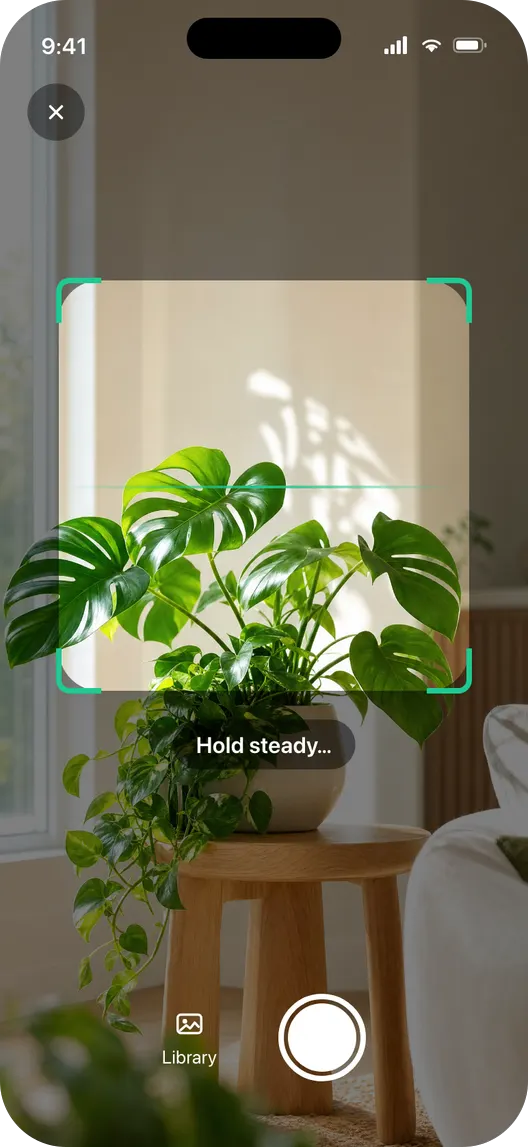
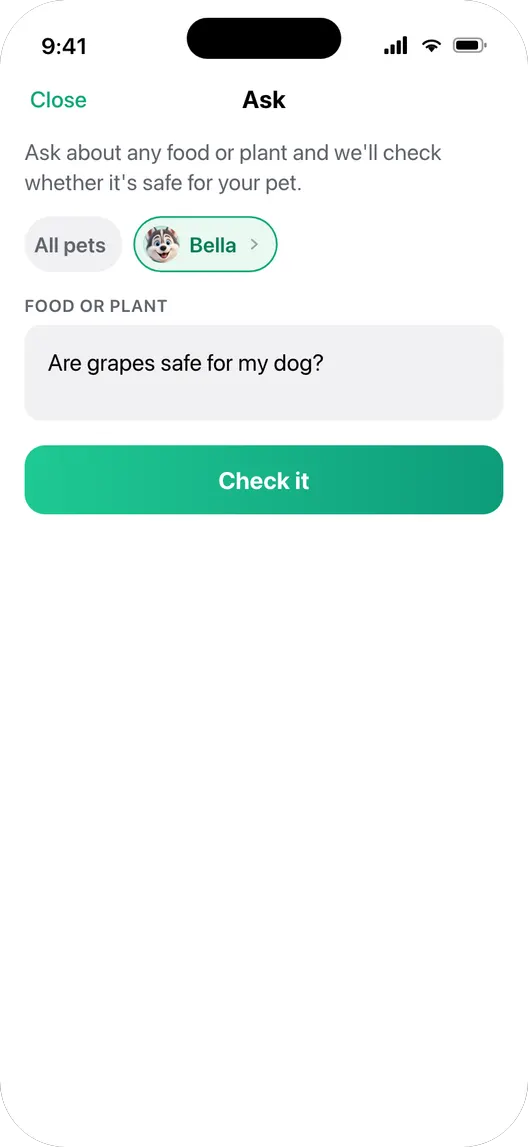
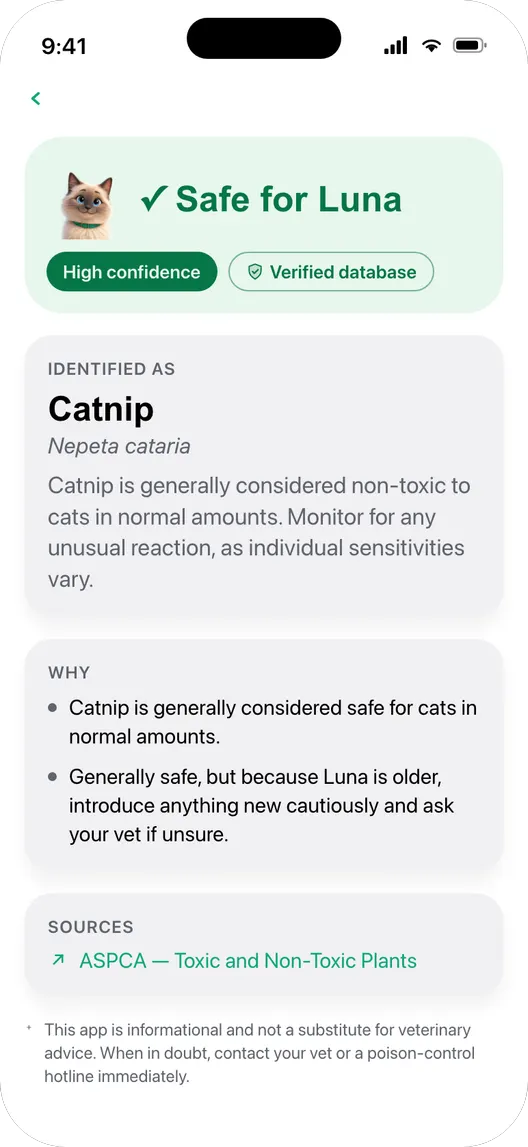
Scan a plant, food, or barcode — or just type the name — and get a toxicity answer for your specific dog or cat. With which source it came from, how confident it is, and what to do next.


Free to try. Unlimited text lookups, no account needed to start.


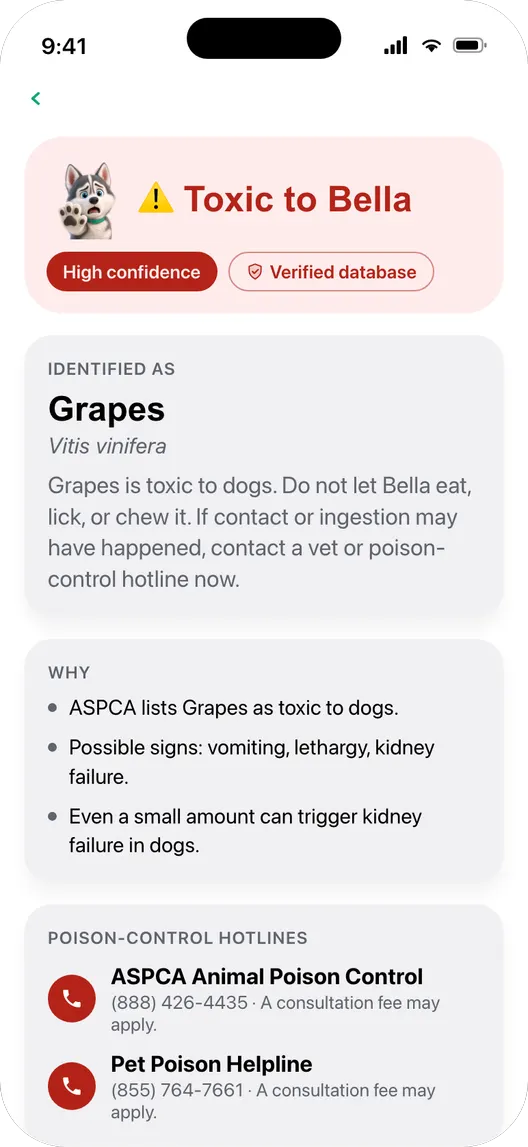
Toxic to Bella
Identified as
Grapes
Vitis vinifera
Why
- ASPCA lists grapes as toxic to dogs.
- Possible signs: vomiting, lethargy, kidney failure.
- Even a small amount can trigger kidney failure in dogs.
- How sure we are.
- A confidence level on every scan result.
- Where it came from.
- A verified reference match, or an answer labelled as AI.
- The actual reasoning.
- The specific facts behind the verdict.
Plant data is sourced from the ASPCA Toxic and Non-Toxic Plants database. The ASPCA does not endorse, certify, or partner with this app.

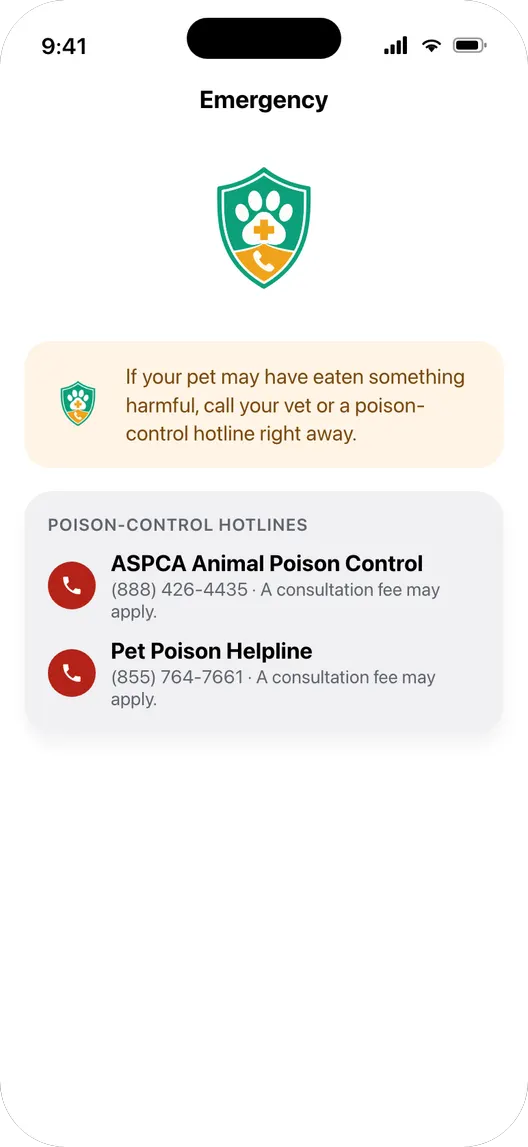
In an emergency, we get out of the way
Both national hotlines, free, whether or not you ever install anything. They are also one tap away inside every toxic result in the app.
Not veterinary advice. Pet Toxicity Lens is informational and is not a substitute for professional veterinary advice, diagnosis, or treatment. If you suspect poisoning, contact your veterinarian or a pet poison-control service immediately.
Where the answer comes from
Database first. AI second. Labelled either way.
Known plants and foods are cross-checked against reference data before anything else. Anything the reference data does not cover is answered by AI — and said to be AI, on the result itself, next to the item it belongs to.
- Plant toxicity data sourced from the ASPCA Toxic and Non-Toxic Plants database — 1,000+ plants.
- A verified reference match is marked as one.
- Off-database answers are marked as AI, never blended in silently.
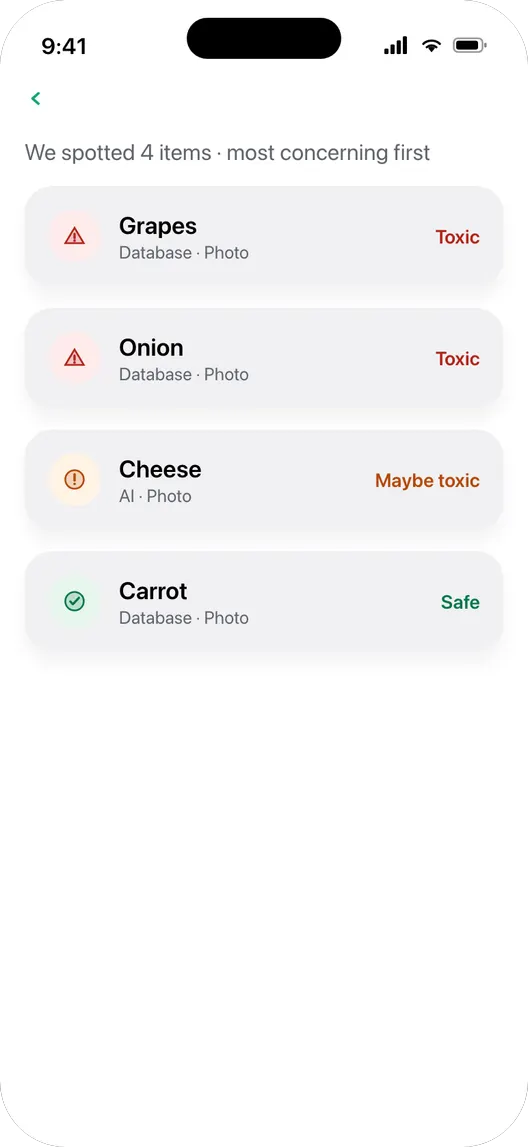
- Several items in one photo are ranked with the most dangerous first.
The ASPCA does not endorse, certify, or partner with this app.
4 items found · ranked by risk
- GrapesVitis viniferaDatabase · PhotoToxic
- Dark chocolateDatabase · PhotoToxic
- Cheese cubesAI · PhotoLikely safe
- Plain crackersAI · PhotoSafe
The uncomfortable part
When we’re not sure, we say so
A safety tool that is always confident is not being careful, it is being useless. These are real states the app will show you.
- Unsure
We couldn't identify this
When the camera is not confident about what it is looking at, it says so and asks you to confirm rather than guessing a name and building a verdict on top of it.
- Maybe toxic
Not in the reference data
Off-database answers come from AI and are labelled as AI, every time. You always know which kind of answer you are reading.
- Hazard
Not toxic, still dangerous
Choking, blockage, sharp edges and entanglement get their own hazard warning, because "non-toxic" is not the same as "safe to swallow".

Personalization
Your pet changes the answer — in one direction only
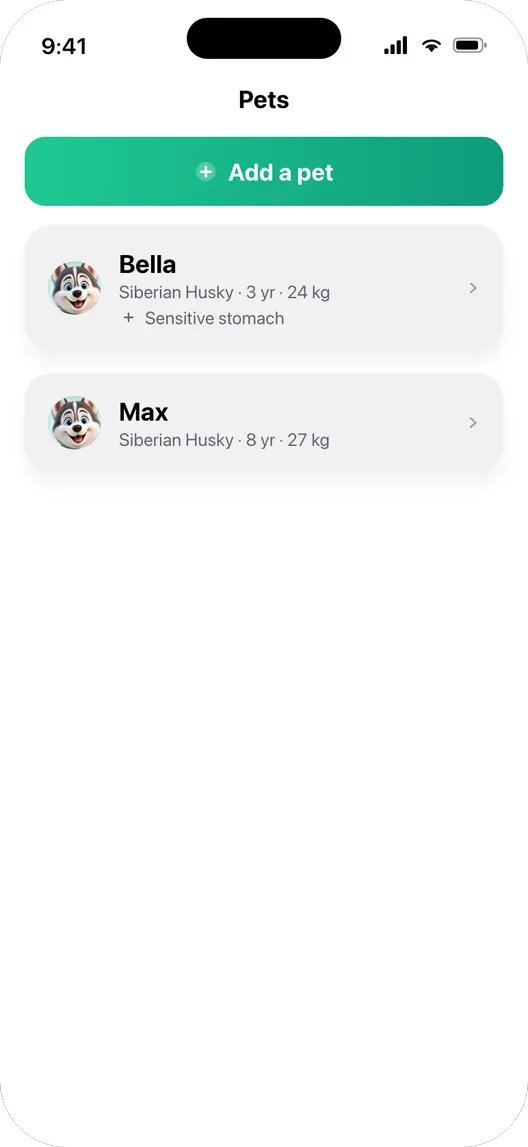
Add your dog or cat once — species, age, weight, breed, health conditions, pregnancy or nursing. Each verdict can then account for them.
Pet details can increase caution. They never make a known toxic item appear safe.
Multi-pet household? One scan can be checked against every pet you have saved.
See the whole app, not a highlight reel
Rendered from the app’s own screens at full resolution.
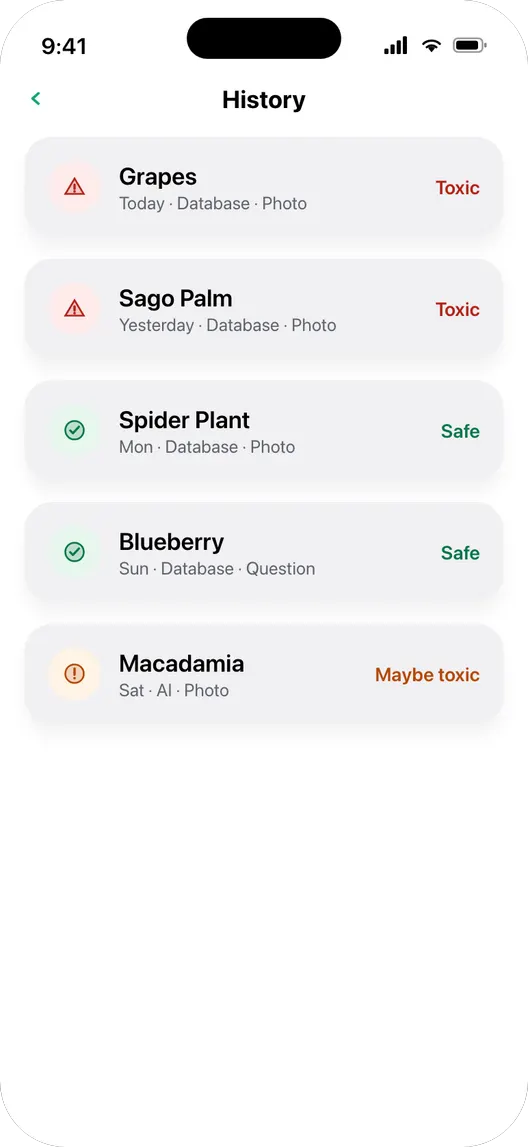
Coverage, honestly
What it checks — and what it doesn’t
Plants
1,000+ plants from the ASPCA reference database, checked before anything else.
Foods
Everyday foods and table scraps, with the common toxic ones verified against reference data.
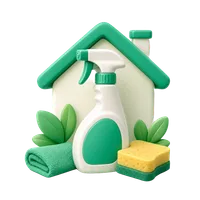
Household products
Cleaners and similar items, identified by camera or barcode where the label is readable.
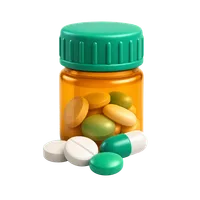
Medications
You can ask about human medicines in the house. There is no reference table for these, so answers are AI and labelled as such.


Things it will not do
- It does not diagnose your pet, and it cannot tell you whether your pet is currently sick.
- It does not know how much your pet actually ate, which is often what decides whether something matters.
- It cannot identify every plant on earth — and it will tell you when it cannot identify one.
- It is not an emergency service. In an emergency, call a vet or a poison-control hotline.
Priced plainly
Start free. The free tier is a real tier, not a teaser.
Free
No cost
- Unlimited text lookups against the built-in reference data
- 3 camera scans, lifetime
- Both poison-control hotlines
- No account needed to start
Pet Toxicity Lens Pro
Unlimited personalized scans, multi-pet checks, scan history, and shareable result cards.
Annual
$59.99/year
7-day free trial
Monthly
$9.99/month
Weekly
$4.99/week
Unlimited scanning is subject to a fair-use cap of 100 scans a day. Your app store shows the exact trial length and price before you confirm, and subscriptions are managed and cancelled there.
Questions
Is this a substitute for calling a vet?
No. It is an informational tool. If your pet has eaten something and you are worried, call your veterinarian or one of the poison-control hotlines — both numbers are on this page for free, and inside every toxic result in the app.
Where does the plant data come from?
Plant toxicity data is sourced from the ASPCA Toxic and Non-Toxic Plants database — 1,000+ plants, checked before anything else. The ASPCA does not endorse, certify, or partner with this app. When an item is not in the reference data, the answer comes from AI and is labelled as AI on the result.
What happens when the app is not sure?
It says so. An uncertain identification stays uncertain rather than being presented as fact, and the app will ask you to confirm what it is looking at instead of guessing a name and building a verdict on top of it.
Does my pet’s profile change the answer?
It can raise the level of caution — for age, weight, breed, pregnancy or nursing status, and health conditions. It can never make a known toxic item appear safe. That rule runs in one direction only, by design.
Can I use it without paying?
Yes. Text lookups against the built-in reference data are unlimited and free, and you get three camera scans. No account is needed to start.
Does it work offline?
There is a basic offline quick check for supported typed items, which returns the raw per-species facts rather than a personalized verdict. Reconnect for a full assessment.
How do I cancel?
Through your App Store or Google Play subscription settings, the same way you manage any other subscription. Cancelling stops the renewal; you keep access until the period you have paid for ends.
Know before they eat it
Free to try, on iPhone and Android. Unlimited text lookups, three camera scans, and both poison-control numbers built in.